Track website visits referred by AI assistants
Hitsteps AI referral tracking identifies supported AI traffic sources when a recognizable referrer or campaign signal reaches your website. Review those referrals in a dedicated report, then connect the source to the landing page and available visitor journey.
- Recognize referral signals from supported AI assistants
- See an AI source overview and matching pageview records
- Keep AI-attributed traffic connected to your wider web analytics
Supported assistant host Campaign
Supported source parameter
AI referral analytics shows which recognized assistants send visits to your site
People increasingly discover products, services, and reference material through conversational AI. When an assistant sends a visitor through a link and supplies usable attribution evidence, Hitsteps can separate that activity from ordinary referral and direct traffic.
Recognized source detection
Match supported assistant hosts and explicit attribution parameters instead of treating every link from an AI product as an unknown referral.
Dedicated AI Referrals report
Open a focused report for matching traffic rather than manually searching a general referrer list for individual assistant domains.
Source overview
See recognized assistants grouped by source for the selected reporting period, based on the matching tracked activity in your account.
Landing-page context
Identify the page that received the AI-attributed activity so you can see which content became the entry point.
Visitor journey context
Review the available page-by-page and returning-visitor context after the referral instead of stopping at the source label.
One analytics workspace
Examine AI-attributed activity alongside the other sources, pages, devices, locations, goals, events, and trends tracked for your site.
AI referrals stay connected to a maintained web analytics workspace
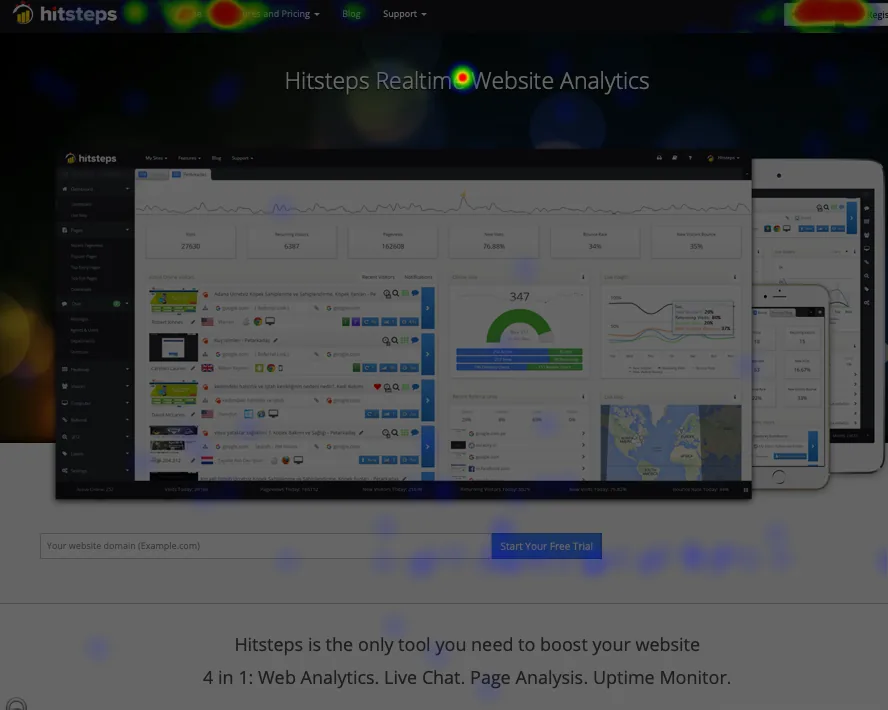
These public product views show the broader Hitsteps dashboard, heatmap, and chat workflow. They provide product context and are not presented as screenshots of the dedicated AI Referrals report.
Maintained for real websites
Hitsteps has kept evolving across website platforms, browser changes, analytics shifts, and store workflows.
Works where your site already lives
WordPress, Shopify, Wix, Google Tag Manager, HTML, CMS, commerce, browser, and desktop setup paths are documented from one hub.
From tracking hit to next action
Live dashboard, visitor profiles, heatmaps, chat, Segments, uptime, reports, and alerts stay connected after tracking is installed.


Hitsteps labels the evidence a visit supplies—it does not guess a missing AI source
AI referral detection depends on referral or campaign information reaching the tracked landing page. Some assistants and browsing flows preserve that information; others suppress it or pass through redirects that remove it.
Supported AI referral source labels
The source registry used by Hitsteps currently contains the following assistant labels. Detection uses the supported hosts and attribution aliases maintained for each source, not a broad keyword guess.
- ChatGPT
- Microsoft Copilot
- Perplexity
- Claude
- Google Gemini
- Grok
- DeepSeek
- Meta AI
- Mistral Le Chat
- Poe
- You.com
- Phind
- NotebookLM
How AI referral tracking works in Hitsteps
Install the Hitsteps tracking tag
Add your website to Hitsteps and install one tracking tag directly or through a supported platform integration. The feature works on the first-party website activity collected for that site.
A visitor follows a link from an AI assistant
The browser loads a page on your website. Depending on the assistant and browsing flow, that request may contain a referring host or a campaign parameter that identifies the source.
Hitsteps checks for supported attribution evidence
The detector compares the available referrer and landing-page attribution values with the maintained source definitions. A recognized match is assigned the corresponding AI assistant label.
Review the AI source with website context
Use the AI Referrals report to review the grouped source overview and matching pageview records, then inspect the landing page and available visitor journey for useful context.
What an AI referral label can—and cannot—tell you
Clear attribution language makes the report useful without overstating what browser referral data can prove.
| Observed signal | What Hitsteps can report | Important limitation |
|---|---|---|
| Supported AI referring host | Attribute matching tracked activity to the recognized assistant. | The referrer can be removed by the assistant, a redirect, the browser, or a privacy control. |
| Supported campaign parameter | Use the explicit source value on the landing URL to label the activity. | The parameter must be present and match a maintained source alias. |
| No recognized source evidence | Record the tracked visit according to the source information that is actually available. | Hitsteps cannot reliably infer that AI influenced the visit. |
| AI crawler fetch, answer mention, or citation without a click | No AI referral is claimed from this feature alone. | Referral analytics is different from crawler monitoring or generative-search visibility measurement. |
Use AI referral analytics to understand traffic after the click
The strongest use of this data is to connect a detected source with what happened on your own website.
- Which recognized AI assistants sent tracked activity during the selected period?
- Which pages became entry points for AI-attributed traffic?
- What pages and actions followed after the landing page?
- Did visitors return after an AI-attributed visit, where returning context is available?
- How does the available journey context differ across sources and landing pages?
- Which AI referral landing pages need a clearer next step for the visitor?
AI referral tracking FAQ
What is AI referral tracking?
AI referral tracking is the attribution of a tracked website visit to an AI assistant when the visit arrives with a recognizable source signal, such as a supported referring host or an explicit campaign parameter. Hitsteps places matching activity in a dedicated AI Referrals report.
Which AI assistants can Hitsteps recognize as referral sources?
Hitsteps currently recognizes referral signals associated with ChatGPT, Microsoft Copilot, Perplexity, Claude, Google Gemini, Grok, DeepSeek, Meta AI, Mistral Le Chat, Poe, You.com, Phind, NotebookLM. Recognition depends on the source information that reaches the website, and the supported-source list can evolve as assistant products and referral formats change.
How does Hitsteps identify an AI referral?
Hitsteps checks the referring host and supported attribution parameters attached to the landing-page URL. When one of those signals matches a recognized AI assistant, the activity can be labeled with that assistant in the AI Referrals report.
Why might an AI-referred visit appear as direct or unattributed traffic?
An AI service, redirect, browser, privacy setting, consent choice, or copied link can remove or omit referral information. If the visit reaches the site without a recognized referrer or campaign signal, Hitsteps cannot reliably identify the AI source and does not infer one.
Does AI referral tracking measure AI crawler visits, model citations, or mentions?
No. This feature attributes tracked website activity after a referral click when a supported source signal is present. It does not claim to measure crawler fetches, prompts, answer impressions, citations without a click, brand mentions inside an AI response, or every visit influenced by AI.
What can I review after Hitsteps detects an AI referral?
The AI Referrals report provides a source overview and matching pageview records. Because the referral is part of Hitsteps web analytics, you can review the available landing-page, visitor, device, approximate location, return-visit, and page-journey context collected for that activity.
See recognized AI referral traffic in your website analytics
Create a Hitsteps account, install the tracking tag, and review supported AI referrals alongside the landing pages and visitor activity that follows.